Recent Posts




























Bihar eastern up is source of all major religions in India post hinduism, >Jainism >Buddhism >Sikhism In fact, same region was hub for North Black Polish Ware culture which coincides with first set of urbanization post fall IVC and it was first ...






frnpff
No.1156
Let's make a thread about Indian governance structures from Monarchy to aristocracy to republicanism. Tell me whatever you know

hwCuGx
No.1173
Explores Indian political ideas across every kaal

heQChn
No.1174
>>1156(OP)
Interesting thread. We should start from mauryas, then stories going from mauryas to guptas to eventually mughals and british and modern day India.



/JnEgv
No.1180
>>1179
 future looks sad

sGnsoj
No.1181
>>1180
yaar bamajeet
/JnEgv
No.1182
>>1181
To us it does, it's the truth. Only good thing about this is we UC won't live that long in the first place so we don't have to deal with the shit hole you will make our of this nation by 30th century.
sGnsoj
No.1183
>>1182
>thinks about 30th century
>currernt : 21st century
yaar, duniya to khatam hone wali hai na beech mai?

NJpbA0
No.1184
>>1156(OP)
from republicanism next will be Authoritarianism or already is
NJpbA0
No.1185
>>1156(OP)
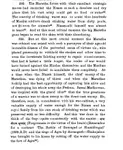
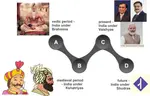
Whats the context of this image its intriguing but i dont know much enlighten if it has some meaning
/JnEgv
No.1186
heQChn
No.1195
>>1179
damn sgtow bros going places
oSlmt/
No.1219
>>1156(OP)
Great, so I made this thread and couldn't contribute anything as I was banned by mods. So I will start with Indus Valley. First thing to know is how we can define a state.
I will take the definition given by classen and skalnik, which states that the early state was a "centralised socio political body, that governed social regulations in a way between two classes; the ruler(elites) and the ruled(commons); with the notion of dominance in leu of protection and submissiviness in leu of service of the latter, all governed by an ideology of transaction and reciprocation"
For this we need some requistes;
Large number of people- check for IVC.
Citizenship determined by birth in the area- no evidence for us but we can say the notion of a city state naturally would invite some permanent residents of the area due to settled living.
Centralised governance and power to mantain law and order- no proof of this. More on this later.
Defence of borders by govt- yes. Surprisingly.
Productivity enough that regular surplus, expansion and non essential tasks can be undertaken- Yes. No qualms about this.
Social stratification. - Yes. To an extent.
Common ideology- no evidence of this.
In coming posts, these will be the standards. As you can say the Indus Valley does fit many of the points in this but not all, so we can call it an incomplete state in many ways. (Or a collection of incomplete states?)
oSlmt/
No.1220
>>1219
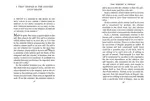
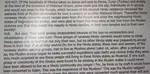
This one is from Thomas Riisfeldt, University of South Wales, one must note that this individual likely represents a politicised take in an attempt to advance the notion that the State is not necessary for social Organisation.
Thomas argues that the Indus Valley lacks an individual king, an official religion and a monopoly of force. But one must remember that here we are relying on , absence of evidence = evidence of absence. Genetic science today has also laid out the distinct ethnic groups that formed the Indus Valley civil, it is very likely that too much top handed ruling of these groups would have caused unnecessary chaos , which could be a reason why the IVC had less of marks of despotic government than in Sumeria.
Fairservis and Malik otoh believe that the Indus valley was not a state but a chief ruled society of elected elders.
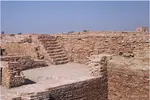
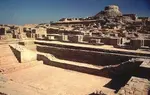
One interesting point he makes is that , there is no evidence of a large scale public monument reaching the skies which suggest a top down religion reflecting the ruler's reach high up unlike the ziggurat. While definitely intriguing, I do not agree as many scholars have speculated that the building we call the great bath likely was for spiritual religious reasons suggesting a more bottoms up spirituality. Let's also not forget that bath is located on the citadel mound, suggesting elite use rather than for all citizens.
>Across the street of The Great Bath, there was a big building with multiple rooms and three verandas, and two staircases leading to the roof and upper floor. Reminding the size of the Great Bath, this building is mostly called as the House of Priests and labelled as "College of Priests.”
oSlmt/
No.1221

>>1220
Another claim thomas makes that we have found no evidence of defensive structures and weaponry is blatantly false. While possible, large scale wars were not done (in the early period) suggesting that defensive capabilities could not have been maintained for police functions is very ignorant.
oSlmt/
No.1222
>>1174
Why Mauryans?
XMOZYJ
No.1255