
Recent Posts



































Mars simulation on urf

HikTYu
No.228
ISRO Analogue Space Mission Begins at 14,000 ft in Ladakh
> A 10-day analogue space mission has started at Tso Kar, Ladakh (14,000 ft), simulating the physiological and psychological effects of long-duration spaceflight in isolation.
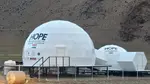
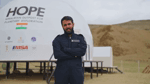
> Conducted at Himalayan Outpost for Planetary Exploration (HOPE), built by Bengaluru-based firm Protoplanet.
> Inaugurated by ISRO Chairman V. Narayanan.
> The analogue crew includes:
- Rahul Mogalapalli, PhD researcher at Purdue University.
- Yaman Akot, planetary science graduate from the University of Aberdeen.
- Selected from 135 applicants based on ISRO guidelines.
> The site was chosen for its terrain similarity to Moon and Mars.
> Backed by Mars Society and Mars Society Australia; logistics support by Mahindra.
> Both crew members:
- Have prior confined habitat simulation experience.
- Underwent medical, psychological, and physical assessments.
- Completed 15-day pre-mission training at lower altitudes.
> The study focuses on:
- Genetic and psychosocial changes due to high-altitude stress.
- Biological sample collection (blood, stool, urine) for “omics” research (genomics, proteomics, metabolomics).
- Monitoring psychological indicators: sleep cycles, mood, decision-making, social interaction.
> Part of ISRO’s Gaganyaan programme and future lunar/planetary crewed missions.
> HOPE is a semi-permanent, modular, dismantlable station, designed for reuse in various future missions.
> Protoplanet will continue to operate HOPE, with collaborations planned with private firms, academics, and experts.
> Future simulations across India will focus on surface mobility, habitat design, and life support systems.
> Results from this and future missions will be released later this year.
HikTYu
No.229
>>228(OP)
HikTYu
No.230

>Dr. V. Narayanan, Chairman, ISRO and Secretary, Department of Space, formally inaugurated ISRO’s high-altitude analog mission HOPE on 31st July 2025.
>The mission is scheduled to be conducted from 1st to 10th August 2025 at Tso Kar, Ladakh (elevation: 4,530 metres).
>Set in one of Earth’s most Mars-like environments, HOPE is designed to simulate planetary conditions for testing human physiological responses, validating mission protocols, and evaluating spaceflight technologies. The mission marks a significant milestone in India’s preparations for future human spaceflight to Low Earth Orbit, and Moon/Mars class exploration missions.
Real kino.
--
https://www.isro.gov.in/Space_Analog_Mission.html there's mission page
Some interesting bits,
>Indian Human Spaceflight Programme is a national endeavor led by ISRO and aims to extend the human presence across solar system, starting with human spaceflight missions to Low Earth Orbit (LEO) and achieving Indian Crewed Lunar Landing by 2040.
If NGLV gets ready crewed lunar landing by 2040 is not far off...a bit ambitious yes considering NGLV is around 2032 or so.
>HOPE is a specially designed Dia 8 metre Habitat Module for crew living and a Dia 5 metre Utility Module for operations and support systems which are interconnected for seamless workflow. Tso Kar valley was specifically selected for this analog mission due to its striking environmental parallels with early Mars, due to high UV flux, low air pressure, cold extremes and saline permafrost.
I wish they release some documentary based off this would be cool to see.

mFUPcu
No.232
>>231
Who funded this project? I know it's not ISRO because of the video we just saw
HikTYu
No.233
>>232
it's ISRO mission only, read that mission page, with industry partner protoplanet and lots of other institituions.
HikTYu
No.239

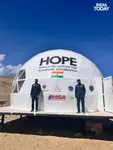
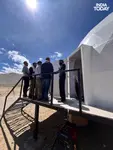
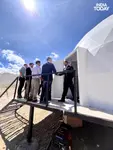
>After 10 days in isolation in the Hope analog habitat, the two astronauts have stepped out and shared their experiences. @IndiaToday was given exclusive access to the hab. Here are some pictures. Detailed story to follow in coming days 🧑🚀🇮🇳🚀🛰️
HikTYu
No.240
>>239
>Two Indian astronauts spent 10 days in isolation at Hope habitat in Ladakh
>Mission simulates lunar and Martian exploration
>Astronauts faced psychological challenges and strict resource rationing
> Two Indian analog astronauts, Rahul Mogalapalli & Yaman Akot, complete 10-day HOPE mission in Tso Kar, Ladakh
> Mission simulates stresses & routines of lunar/Martian exploration
> Conducted in Himalayan Outpost for Planetary Exploration (HOPE) habitat — Phobos & Deimos modules
> Developed by Bengaluru-based Protoplanet with ISRO’s Human Space Flight Centre
> Habitat faced extreme temps from +35°C to −25°C
> Astronauts rationed food, water & internet; faced psychological challenges of isolation
> Biomedical tests done: urine, breath & blood samples for physiological & psychological analysis
> Data to aid Gaganyaan mission & future Moon/Mars missions
> Plans to expand habitat for 6 astronauts; next simulation set for April 2026
> Current modules will act as automated weather stations until next mission
> key rehearsal for Indian astronauts walking on Moon & Mars in future